



NEWS CENTER

Solartech Shines at UNCCD COP17
Source:Solartech Shenzhen
Date:2026-08-20
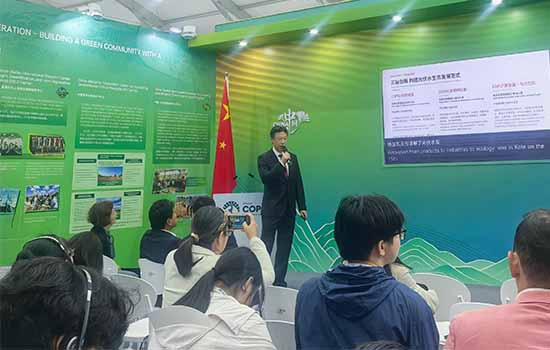
Reprinted on On 18 August, the 17th session of the Conference of the Parties (COP17) to the United Nations Convention to Combat Desertification (UNCCD) entered its second day in Ulaanbaatar, Mongolia. At the side event titled "Solar‑Powered Land and People: Off‑Grid Solar Empowerment in Arid Regions," held in the China Pavilion of the Blue Zone, Shi Hongfeng, Chairman of Solartech Renewable Energy Co., Ltd., delivered a keynote report entitled "Solar Water Ecosystem: A Systemic Approach to Supporting Desert Restoration and Food Security." The presentation systematically laid out a Chinese solution – a "solar water ecosystem" built around solar water pumping, integrated with ecological agriculture and green finance – which drew significant attention from delegates, international organisations, and research institutions from around the world.
I. Responding to the Conference Theme: From "Combating Desertification" to "Integrated Land Management"
This year's COP17, under the theme "Restore Land, Reignite Hope," brought together representatives from 197 Parties, as well as international organisations, research bodies, and businesses, to discuss degraded land restoration, sustainable land management, drought resilience, and grassland conservation and restoration. Compared with previous COPs, this year's conference reflects three clear shifts: land degradation is moving from a purely environmental issue towards a broader agenda encompassing food security, water security, development finance, and climate adaptation; the international community is moving from making "funding pledges" to establishing concrete "financing mechanisms"; and governance is expanding from "government‑led" to multi‑stakeholder collaboration involving governments, businesses, financial institutions, communities, and research institutes.
Statistics show that arid zones cover 41% of the world's land surface, and more than 2 billion people live in arid and semi‑arid areas. In the host country, Mongolia, 81.9% of its territory has already been affected by desertification and land degradation. The vicious cycle of water scarcity, lack of electricity, and land degradation poses a grave challenge to agricultural irrigation and food security. Against this backdrop, there is a growing international expectation for businesses to contribute to global desertification control through technological innovation and market‑based solutions.
II. Addressing the Core Challenges: The "Four Bottlenecks" of Water Scarcity, Technology Gaps, Funding Shortages, and Unsustainable Operations
In his report, Chairman Shi highlighted four long‑standing systemic bottlenecks in global desertification control:
- Water scarcity intertwined with energy poverty – remote arid regions lack grid coverage, and traditional diesel‑powered pumping is both costly and polluting.
- Missing "last‑mile" technical services – advanced irrigation and agronomic practices often fail to reach the field.
- Difficult and expensive project financing – ecological restoration requires substantial upfront investment with long payback periods.
- Prioritising construction over operation – many water facilities lose effectiveness due to a lack of ongoing maintenance.
"Desertification control is not simply about planting trees and watering them; it is a systemic project involving energy, water resources, agriculture, finance, and community operations," Shi emphasised. "Only by establishing a complete chain – from securing water, to using water efficiently, to ensuring sustainability – can we truly turn deserts into oases and oases into productive farmland."
III. Three‑Tier Innovation Evolution: Building a Solar Water Ecosystem Development Paradigm
To address these challenges, Solartech has, over more than two decades of practice, developed a three‑tier innovation path – from product innovation, to industry innovation, to industrial‑chain innovation:
Tier 1 – Product Innovation: Solar Water Pumping Systems. Powered solely by solar energy, photovoltaic arrays drive pumps directly without the need for grid connection or battery storage – using water during the day and storing water instead of electricity. Compared with conventional diesel pumping, operating costs are reduced by over 70%, with zero carbon emissions, making it especially suitable for remote arid and desertified areas. These systems have been deployed in more than 130 countries and regions, covering domestic water supply, water‑saving irrigation, seawater desalination, grassland animal husbandry, and desertification control.
Tier 2 – Industry Innovation: Solar Water Resources. This integrates solar power with water engineering, water‑saving irrigation, and smart water management. By using solar energy to overcome the challenges of long distances, long lead times, high costs, and low efficiency in remote rural areas without grid access, it serves global ecological restoration, farmland reclamation, food production increases, and improvement of living environments.
Tier 3 – Industrial‑Chain Innovation: Solar Water Ecosystem. This is the new paradigm formally proposed by Solartech at COP17. It leverages the green, low‑carbon advantages of solar pumping, combined with complementary multi‑energy optimisation, to cover the entire water cycle – from water resource development, water infrastructure construction and operation, water body monitoring and protection, water quality improvement, to wastewater purification. It provides new energy solutions for agriculture, forestry, animal husbandry, and fishery production, construction, and processing, achieving an integrated "survival, production, ecology" model.
From COP15 in Côte d'Ivoire ("Solar Water Pumps Empower Land and People"), to COP16 in Saudi Arabia ("Solar Water Resources Empower Land and People"), and now to COP17 in Mongolia ("Solar Water Ecosystem Empowers Land and People"), Solartech's journey reflects the inevitable evolution of global desertification control – from isolated technological breakthroughs towards systemic ecosystem solutions.
IV. The Trinity Solution: Energy‑Water Infrastructure + Ecological Agricultural Services + Green Capital Integration
Under the solar water ecosystem paradigm, Solartech proposes a closed‑loop "trinity" solution:
1. Solar‑Water Infrastructure Foundation. With solar pumping at its core, this creates distributed, zero‑carbon, low‑cost energy‑water nodes covering drinking water for humans and livestock, agricultural irrigation, and ecological water replenishment. Through standardised site construction, remote intelligent operation and maintenance, adaptable multi‑scenario configurations, and pay‑as‑you‑go models, it ensures stable water supply in arid regions.
2. Ecological Agricultural Services. Building on the energy‑water nodes, this adds a one‑stop rural production service package integrating "water + agricultural inputs + agronomic techniques + machinery + sales." It deploys soil moisture monitoring, AI‑based crop models, and low‑altitude drone operations, while training local maintenance and agronomic staff – forming a complete chain from "growing well" to "selling well."
3. Green Capital Integration. Using carbon sink revenues, agricultural output, and policy subsidies as repayment sources, it establishes a multi‑tiered financial system comprising "policy‑guided funds + green industrial funds as the lead + supply‑chain finance as support + carbon sink revenue as supplement + user installment payments." In addition, digitalisation of rural assets (land use rights, water rights, and carbon assets on the blockchain) unlocks dormant rural capital, creating a full‑cycle funding loop from investment and construction to operation.
"Solar‑water infrastructure secures water, ecological agriculture ensures efficient water use, and capital integration guarantees sustainability – the three pillars reinforce each other to form a complete ecosystem," Chairman Shi concluded in his speech.
V. 25 Years of Deep Cultivation: A Pioneer in Solar Water Resources from Shenzhen to the World
Solartech Renewable Energy Co., Ltd., headquartered in Shenzhen, is a global pioneer and leader in the solar water resources sector, with more than 25 years of dedicated R&D and commercial application of solar water pumping technology. Its core products – solar pumping systems and integrated solutions – are widely used in agricultural irrigation, desertification control, animal husbandry, and improvement of human settlements, with products and services covering over 130 countries and regions.
In 2014, Solartech, jointly with Tsinghua University, received the "United Nations Global Human Settlements Green Technology Model Award," becoming the first solar water resources company to win this honour. In recent years, the company has successively participated in UNCCD COP15, COP16, and this year's COP17, continuously sharing China's technical expertise and industrial practices in desertification control with the international community.
In terms of market presence, Solartech has built a global channel network covering key regions along the Belt and Road, including Southeast Asia, the Middle East and North Africa, sub‑Saharan Africa, Latin America, and Central Asia. It has established local service teams in Uganda, Kenya, Laos, Thailand, Cambodia, Brazil, Chile, Saudi Arabia, Iraq, and other countries, driving the upgrade of solar water resources technology from "product export" to "ecosystem export."
VI. Call for Cooperation: Building a Global Solar Water Ecosystem Partnership
At the end of his report, Chairman Shi extended a global cooperation initiative, calling on:
- Governments and international organisations to align policies, pilot projects, co‑build ecological compensation mechanisms, and promote synergy between climate finance and desertification funds;
- Financial and investment institutions to co‑create green funds, carbon trading mechanisms, and supply‑chain finance, and to provide project financing and insurance enhancement;
- Industrial and technology partners to collaborate in solar manufacturing, smart agriculture, drone‑based plant protection, agricultural input distribution, EPC construction, and O&M services;
- Research and think‑tank organisations to jointly set standards, develop carbon accounting methodologies, and share talent development programmes.
"Let every ray of sunshine become a spring of fresh water, let every desert regain its vitality, and let the world of water be filled with sunshine!" said Shi Hongfeng. "Solartech is ready to join hands with global partners to implement the solar water ecosystem approach, supporting the UN 2030 Agenda for Sustainable Development and contributing Chinese wisdom, Chinese solutions, and Chinese strength to global land restoration and food security."
This year's COP17, under the theme "Restore Land, Reignite Hope," brought together representatives from 197 Parties, as well as international organisations, research bodies, and businesses, to discuss degraded land restoration, sustainable land management, drought resilience, and grassland conservation and restoration. Compared with previous COPs, this year's conference reflects three clear shifts: land degradation is moving from a purely environmental issue towards a broader agenda encompassing food security, water security, development finance, and climate adaptation; the international community is moving from making "funding pledges" to establishing concrete "financing mechanisms"; and governance is expanding from "government‑led" to multi‑stakeholder collaboration involving governments, businesses, financial institutions, communities, and research institutes.
Statistics show that arid zones cover 41% of the world's land surface, and more than 2 billion people live in arid and semi‑arid areas. In the host country, Mongolia, 81.9% of its territory has already been affected by desertification and land degradation. The vicious cycle of water scarcity, lack of electricity, and land degradation poses a grave challenge to agricultural irrigation and food security. Against this backdrop, there is a growing international expectation for businesses to contribute to global desertification control through technological innovation and market‑based solutions.
II. Addressing the Core Challenges: The "Four Bottlenecks" of Water Scarcity, Technology Gaps, Funding Shortages, and Unsustainable Operations
In his report, Chairman Shi highlighted four long‑standing systemic bottlenecks in global desertification control:
- Water scarcity intertwined with energy poverty – remote arid regions lack grid coverage, and traditional diesel‑powered pumping is both costly and polluting.
- Missing "last‑mile" technical services – advanced irrigation and agronomic practices often fail to reach the field.
- Difficult and expensive project financing – ecological restoration requires substantial upfront investment with long payback periods.
- Prioritising construction over operation – many water facilities lose effectiveness due to a lack of ongoing maintenance.
"Desertification control is not simply about planting trees and watering them; it is a systemic project involving energy, water resources, agriculture, finance, and community operations," Shi emphasised. "Only by establishing a complete chain – from securing water, to using water efficiently, to ensuring sustainability – can we truly turn deserts into oases and oases into productive farmland."
III. Three‑Tier Innovation Evolution: Building a Solar Water Ecosystem Development Paradigm
To address these challenges, Solartech has, over more than two decades of practice, developed a three‑tier innovation path – from product innovation, to industry innovation, to industrial‑chain innovation:
Tier 1 – Product Innovation: Solar Water Pumping Systems. Powered solely by solar energy, photovoltaic arrays drive pumps directly without the need for grid connection or battery storage – using water during the day and storing water instead of electricity. Compared with conventional diesel pumping, operating costs are reduced by over 70%, with zero carbon emissions, making it especially suitable for remote arid and desertified areas. These systems have been deployed in more than 130 countries and regions, covering domestic water supply, water‑saving irrigation, seawater desalination, grassland animal husbandry, and desertification control.
Tier 2 – Industry Innovation: Solar Water Resources. This integrates solar power with water engineering, water‑saving irrigation, and smart water management. By using solar energy to overcome the challenges of long distances, long lead times, high costs, and low efficiency in remote rural areas without grid access, it serves global ecological restoration, farmland reclamation, food production increases, and improvement of living environments.
Tier 3 – Industrial‑Chain Innovation: Solar Water Ecosystem. This is the new paradigm formally proposed by Solartech at COP17. It leverages the green, low‑carbon advantages of solar pumping, combined with complementary multi‑energy optimisation, to cover the entire water cycle – from water resource development, water infrastructure construction and operation, water body monitoring and protection, water quality improvement, to wastewater purification. It provides new energy solutions for agriculture, forestry, animal husbandry, and fishery production, construction, and processing, achieving an integrated "survival, production, ecology" model.
From COP15 in Côte d'Ivoire ("Solar Water Pumps Empower Land and People"), to COP16 in Saudi Arabia ("Solar Water Resources Empower Land and People"), and now to COP17 in Mongolia ("Solar Water Ecosystem Empowers Land and People"), Solartech's journey reflects the inevitable evolution of global desertification control – from isolated technological breakthroughs towards systemic ecosystem solutions.
IV. The Trinity Solution: Energy‑Water Infrastructure + Ecological Agricultural Services + Green Capital Integration
Under the solar water ecosystem paradigm, Solartech proposes a closed‑loop "trinity" solution:
1. Solar‑Water Infrastructure Foundation. With solar pumping at its core, this creates distributed, zero‑carbon, low‑cost energy‑water nodes covering drinking water for humans and livestock, agricultural irrigation, and ecological water replenishment. Through standardised site construction, remote intelligent operation and maintenance, adaptable multi‑scenario configurations, and pay‑as‑you‑go models, it ensures stable water supply in arid regions.
2. Ecological Agricultural Services. Building on the energy‑water nodes, this adds a one‑stop rural production service package integrating "water + agricultural inputs + agronomic techniques + machinery + sales." It deploys soil moisture monitoring, AI‑based crop models, and low‑altitude drone operations, while training local maintenance and agronomic staff – forming a complete chain from "growing well" to "selling well."
3. Green Capital Integration. Using carbon sink revenues, agricultural output, and policy subsidies as repayment sources, it establishes a multi‑tiered financial system comprising "policy‑guided funds + green industrial funds as the lead + supply‑chain finance as support + carbon sink revenue as supplement + user installment payments." In addition, digitalisation of rural assets (land use rights, water rights, and carbon assets on the blockchain) unlocks dormant rural capital, creating a full‑cycle funding loop from investment and construction to operation.
"Solar‑water infrastructure secures water, ecological agriculture ensures efficient water use, and capital integration guarantees sustainability – the three pillars reinforce each other to form a complete ecosystem," Chairman Shi concluded in his speech.
V. 25 Years of Deep Cultivation: A Pioneer in Solar Water Resources from Shenzhen to the World
Solartech Renewable Energy Co., Ltd., headquartered in Shenzhen, is a global pioneer and leader in the solar water resources sector, with more than 25 years of dedicated R&D and commercial application of solar water pumping technology. Its core products – solar pumping systems and integrated solutions – are widely used in agricultural irrigation, desertification control, animal husbandry, and improvement of human settlements, with products and services covering over 130 countries and regions.
In 2014, Solartech, jointly with Tsinghua University, received the "United Nations Global Human Settlements Green Technology Model Award," becoming the first solar water resources company to win this honour. In recent years, the company has successively participated in UNCCD COP15, COP16, and this year's COP17, continuously sharing China's technical expertise and industrial practices in desertification control with the international community.
In terms of market presence, Solartech has built a global channel network covering key regions along the Belt and Road, including Southeast Asia, the Middle East and North Africa, sub‑Saharan Africa, Latin America, and Central Asia. It has established local service teams in Uganda, Kenya, Laos, Thailand, Cambodia, Brazil, Chile, Saudi Arabia, Iraq, and other countries, driving the upgrade of solar water resources technology from "product export" to "ecosystem export."
VI. Call for Cooperation: Building a Global Solar Water Ecosystem Partnership
At the end of his report, Chairman Shi extended a global cooperation initiative, calling on:
- Governments and international organisations to align policies, pilot projects, co‑build ecological compensation mechanisms, and promote synergy between climate finance and desertification funds;
- Financial and investment institutions to co‑create green funds, carbon trading mechanisms, and supply‑chain finance, and to provide project financing and insurance enhancement;
- Industrial and technology partners to collaborate in solar manufacturing, smart agriculture, drone‑based plant protection, agricultural input distribution, EPC construction, and O&M services;
- Research and think‑tank organisations to jointly set standards, develop carbon accounting methodologies, and share talent development programmes.
"Let every ray of sunshine become a spring of fresh water, let every desert regain its vitality, and let the world of water be filled with sunshine!" said Shi Hongfeng. "Solartech is ready to join hands with global partners to implement the solar water ecosystem approach, supporting the UN 2030 Agenda for Sustainable Development and contributing Chinese wisdom, Chinese solutions, and Chinese strength to global land restoration and food security."





 Interested in Solartech

